

Most heirloom jewelry is never worn again. Here's what separates the pieces that survive a generation from the ones that don't.
Almost everyone has one. A small box, inherited, holding pieces that belonged to a grandmother or a great-aunt or a mother — and that have not been on a human body in twenty years.
The pieces are often lovely. They are almost always meaningful. And they sit there anyway, moved from house to house across decades, opened occasionally and looked at with real feeling, and then closed again.
This is the quiet failure of the heirloom. We talk constantly in this industry about jewelry that lasts for generations, and we're usually talking about durability — as though the challenge were physical. It isn't. Gold survives fine. What fails is the handoff. The metal makes it to the next generation intact and simply never gets worn, which means that for all practical purposes it didn't make it at all.
If you're buying now with any thought toward the woman who'll open your box in forty years, the useful question isn't will this last. It's will she actually put it on. Those turn out to be very different questions, and the second one has answers.
Why Inherited Jewelry Stays in the Box
Three things go wrong, and they go wrong far more often than sentiment or taste.
It doesn't fit. This is the largest and least discussed failure by a wide margin. Rings arrive two sizes off. Bangles were made for a smaller wrist. Necklace chains sit at a length that suited another woman's proportions and another decade's necklines. A piece that doesn't fit isn't worn once, and a piece that isn't worn once tends never to be worn at all — the moment passes, the box closes, and the intention quietly expires.
The format has aged out. Not the style, the format. Clip-on earrings inherited by someone with pierced ears. A brooch, in a world where almost nobody wears brooches. A cocktail ring scaled to an evening culture that has largely dissolved. The design may be beautiful and the piece may still be entirely wearable in principle — but there's no slot in a modern week where it goes.
Nobody feels permitted to change it. This is the one that does the most damage, and we'll come back to it, because it's the failure most within your control.
The Permission Problem
Here is what happens. A woman inherits her grandmother's ring. It's a size 4.5; she's a 7. She takes it to a jeweler, is told it can be sized, and then — almost universally — hesitates. It feels like an alteration of the thing itself. Like cutting a page out of a book. So she puts it back in the box, promising herself she'll deal with it, and the ring enters its second decade of not existing.
We'd like to say this plainly: resizing a ring, shortening a chain, remounting a stone, and replacing a worn clasp are all acts of preservation, not damage. Jewelry has been altered by every generation that owned it for as long as jewelry has existed. The stone in a Victorian ring was frequently older than the ring. Reworking a piece so it can be worn is the most faithful thing you can possibly do with it — considerably more faithful than leaving it pristine and unused in a drawer, which is only a slower way of losing it.
If you take one practical thing from this: the pieces you've inherited and haven't worn should go to a jeweler this year. Not for appraisal. For adjustment.
What Actually Survives a Generation
Once you've watched enough pieces succeed and fail at this, patterns emerge. The survivors tend to share four traits, and none of them are about how much the piece cost.
Solid metal, not plated or hollow. Plating wears through — always, eventually — and once it does, the piece can be replated but never quite restored. Hollow chains kink and can't be repaired cleanly. Solid 14kt gold can be resized, resoldered, refinished, and reworked essentially indefinitely, which means a solid piece is repairable in forty years and a plated one is disposable. The Delicate Cable Chain Necklace is a modest piece by any measure, but it's solid gold, which means it's a genuine candidate for outliving you. Most chains at that price point are not.
Protected stones. Prongs wear down. They snag on fabric, they thin over decades of contact, and stones are lost — the single most common way an heirloom is diminished. Bezel settings, where a rim of gold fully encircles the stone, are markedly more forgiving over long timelines. The Mini Bezel-Set Round Birthstone Bracelet and the Heart Birthstone Bezel-Set Bracelet are both built this way. It's an aesthetic choice, but it's a longevity choice first.
Modularity. This is the underrated one. A pendant and a chain sold as separate decisions is a piece that can be re-scaled to whatever body and whatever era receives it — a new chain costs a fraction of a new pendant, and the meaningful part travels unchanged. Our Lila diamond pendants were designed with exactly this in mind: a full carat that pairs with the Gold Omega Chain Necklace now and with something else entirely in thirty years. Compare that to a fixed-chain necklace, where the whole piece lives or dies by one length decision made once.
Neutral scale. The pieces that transfer well are almost never the loudest ones. The Classic Diamond Studs and the Small Gold Tube Hoops survive generations for an unglamorous reason: they don't belong to a moment, so there's no moment for them to fall out of. Neither has a decade attached to it.
The Resizing Question Nobody Asks
Buy a ring for a future you can't see and you're making an implicit bet on someone's ring size. Some designs let you hedge that bet; some don't. This is worth understanding before you buy, not after.
A full eternity band — diamonds set continuously all the way around the shank — is beautiful precisely because it has no beginning and no end, and that same quality makes it very difficult to resize. There's no plain metal to cut into and no way to add or remove length without disturbing the setting. The 1.3 Carat Classic Natural Diamond Eternity Ring and Olivia's 3 Carat Mixed Shape Eternity Band are magnificent pieces, and you should buy them for the woman wearing them today rather than as a bet on a future finger.
A halfway eternity solves this. Stones across the top, plain gold underneath — which means a jeweler has somewhere to work. The Mixed Shape Diamond Halfway Eternity offers essentially the same face-up presence with a generation's worth of adjustability built in. If a ring is intended to travel, this is the structural choice that lets it.
Bangles carry a version of the same issue — they're sized to a wrist and don't adjust — which is worth knowing about the Gold Taylor Wave Bangle before it's wrapped rather than after. Bracelets with a clasp, like the Curb Chain Bracelet, are more forgiving across bodies.
None of this is an argument against the unadjustable pieces. It's an argument for knowing which decision you're making.
Personalization That Travels
Here is a counterintuitive thing about personalized jewelry and inheritance: single initials transfer beautifully and full names almost never do.
Families reuse letters. A granddaughter named for her grandmother, a middle name carried down, a surname that holds across four generations — a single gold letter has a real chance of landing on someone who reads it as hers rather than as someone else's. The 14K Gold Mini Initial Necklace and the Gold Initial Ring are the most inheritable personalized pieces we make, for this reason and no other.
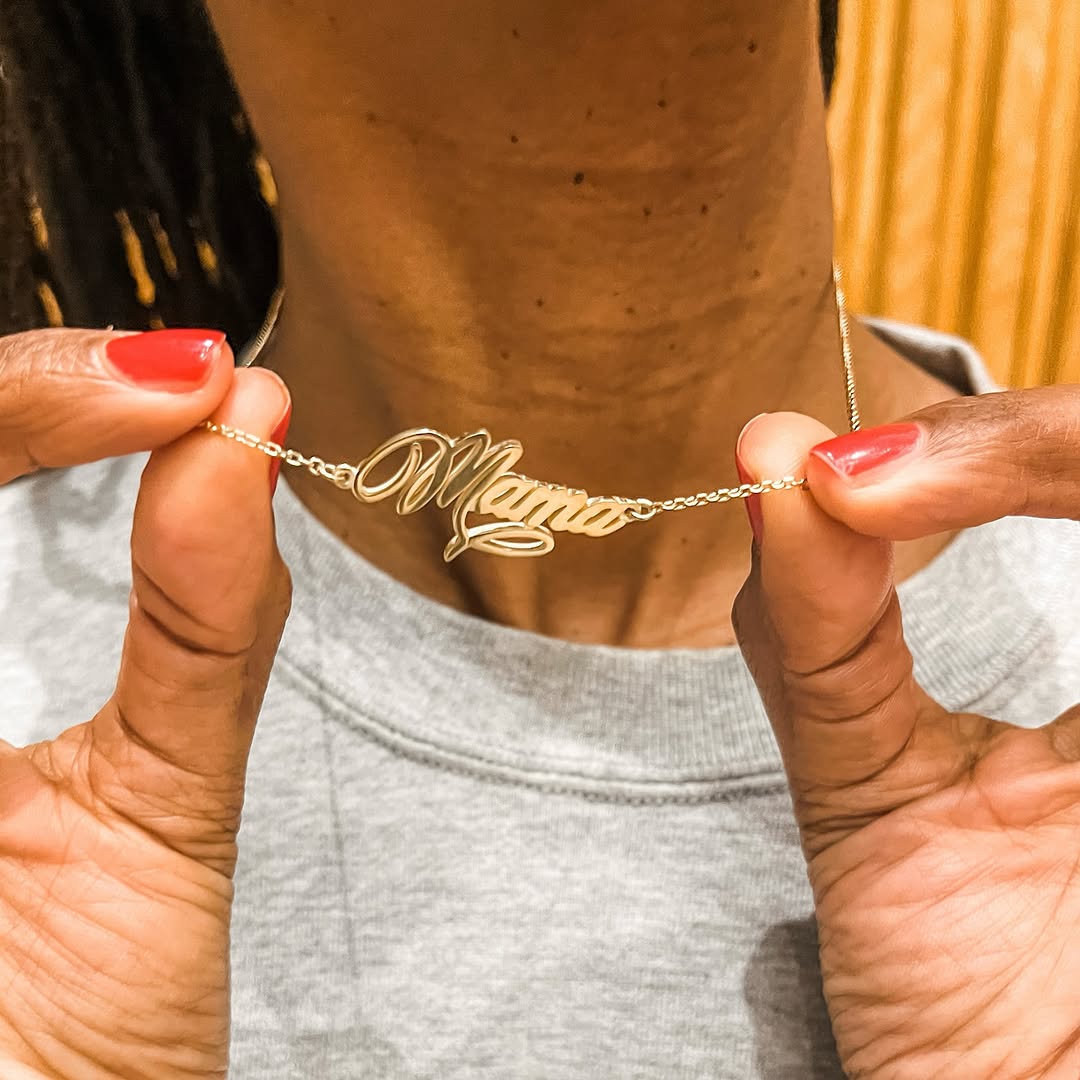
A full name in script is a different object. The Personalized Diamond Script Name Necklace is one of the most beautiful things in our collection and we'd never talk anyone out of it — but it belongs to one woman, permanently and completely, and it should be bought that way. The same is true of the Diamond Mama Necklace. Some pieces are meant to be a portrait rather than a bequest, and there's nothing wrong with that as long as you know which you're buying.
Engraving splits the difference nicely: the piece reads as neutral to anyone glancing at it, and the meaning is carried on the back where it doesn't constrain who can wear it. That's the quiet logic of the Engravable Horizontal Pendant Necklace — a date, a set of initials, a word, held privately.
Buy for the Wearer, Not the Descendant
All of which leads somewhere slightly against expectation.
The pieces that get inherited well are, overwhelmingly, the pieces that were worn well. Not the ones bought with an heir in mind — those tend to be a little stiff, a little formal, chosen for an imagined future taste that never arrives and consequently loved by nobody, including the buyer. The ones that survive are the ones that were on a woman's body constantly, that appear in every photograph of her across fifteen years, that her daughter can't picture her without.
That's what makes an heirloom: not the carat weight, and not the intention. Association. A Signature Classic Diamond Tennis Bracelet worn twice is an asset someone will eventually sell. Worn every day for twenty years, it's the thing her daughter will put on the morning of her own wedding, and there is no version of the world in which that one gets sold.
So buy what you'll wear now. The inheritance takes care of itself, and it takes care of itself precisely by being used.
Write It Down, and Give It Early
Two last things, both small, both disproportionately effective.
Write the stories down. A piece without narrative is metal at market value; a piece with a documented story is an heirloom. A single sheet of paper in the box — what each thing is, when it was bought, who wore it, what was happening that year — is genuinely the difference. Almost nobody does this. It takes twenty minutes and it is the highest-leverage act of preservation available to you.
And consider giving things away while you're alive. There's an assumption baked into the word inheritance that the handoff happens at the end. It doesn't have to. Giving a piece to a daughter at thirty rather than at sixty means thirty additional years of it being worn, and it means you're there to tell her what it meant — which is the part that can't be replaced later, and the part that most often gets lost.
Jewelry doesn't become an heirloom when someone dies. It becomes one when someone wears it long enough that it stops being an object and starts being a fact about a person. Everything else is just storage.


